
Save Water and Avoid NTA: Eco-Friendly Car Detailing for U.S. Drivers
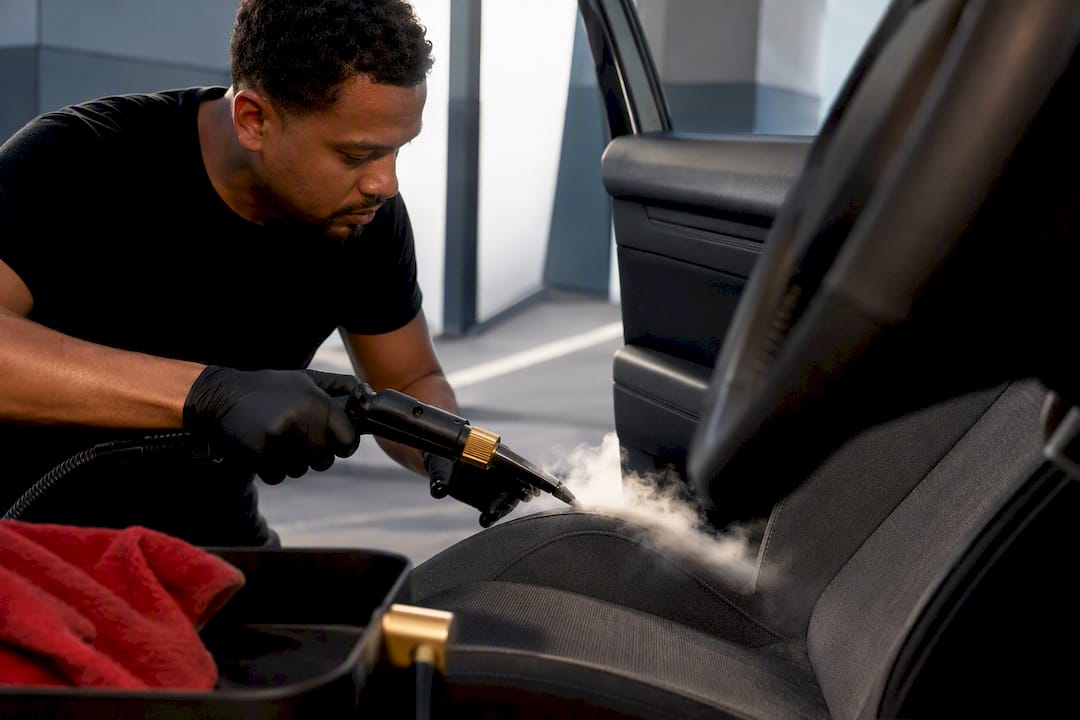
Eco-friendly car detailing combines water-saving methods, like waterless washing, steam cleaning, or reclamation systems, with biodegradable, NTA-free products that skip the harsh chemicals traditional car washes rely on. For most owners, the smartest move is hiring a trained mobile detailer who already uses these methods, or if you’re doing it yourself, sticking to steam and waterless techniques rather than a hose and a bucket of standard soap.
TL;DR:
Waterless and steam cleaning techniques significantly reduce water use, with some systems using as little as one gallon per service.
Choosing NTA-free, plant-based, biodegradable products limits chemical runoff, lowers indoor chemical exposure, and helps protect waterways.
Ceramic coatings and paint protection film decrease the frequency of washes needed, providing long-term environmental savings for daily drivers.
Reputable eco-friendly detailers use runoff containment, microfiber management, route optimization, and energy-efficient tools to minimize environmental impact.
DIY advancements are suitable for light routine cleaning, but professional services are safer for intensive jobs involving coatings, PPF, or delicate interior work.
Table of Contents
Why Eco-Friendly Detailing Matters for Your Car and Your Water Bill
A traditional home car wash burns through a large amount of water per session, most of it running straight down the driveway and into the storm drain. That runoff carries whatever soap, degreaser, and road grime came off your car with it, and municipal storm systems in most U.S. cities do not treat that water before it reaches local creeks and waterways.
The gap is wider than most owners realize. Waterless wash concentrates can clean and protect a full vehicle with close to zero running water, while steam-based systems sanitize interiors using as little as one gallon per service. That is not a marginal improvement. It’s the difference between a car wash that pollutes a watershed and one that barely touches it.
The chemical side matters just as much as the water. Conventional detailing sprays often lean on high-VOC solvents that off-gas into the air you and your passengers breathe for weeks after a detail. Some also contain chelating agents like NTA, compounds designed to grab onto minerals and heavy metals so they rinse away easily, which is exactly why they’re a problem once they reach a waterway. They persist, and they carry those metals with them.
Choosing eco-conscious methods gets you three concrete wins: less chemical exposure inside your own car, a lower water bill if you’re washing at home, and often better long-term paint condition because harsh degreasers and abrasive rinsing wear down wax and sealant faster than gentler alternatives.
What Are the Main Eco-Friendly Detailing Methods?
Not every green method fits every situation. Here’s how the four most common approaches actually work, and where each one falls short.
Waterless wash systems. These use a lubricating, biodegradable spray that encapsulates dirt so a microfiber towel lifts it off without grinding it into the paint. EcoSmart-style concentrates can save dozens of gallons per wash compared to a hose-and-bucket approach. They work well on light dust and pollen but struggle with heavy mud, brake dust buildup, or anything caked on from a dirt road, since scrubbing dry grime without enough lubrication risks scratching the clear coat.
Steam cleaning. High-temperature vapor breaks down grime and kills bacteria and odor-causing microbes without chemical cleaners, using a fraction of the water of a rinse-based wash. It shines on interiors, seats, carpets, vents, and door jambs, and pairs well with pH-balanced, steam-compatible cleaners for fabric sanitizing. The tradeoff: steam equipment runs hot enough to damage certain trim or leather if a detailer isn’t trained on dwell time, so this is one method where professional experience earns its cost.
Low-water washing with reclamation. Some mobile detailers use a controlled, low-flow rinse paired with a containment mat that captures and filters runoff before it hits the ground. It handles moderate soil loads, road salt, and heavier grime better than waterless alone, while still cutting total water use well below a garden hose wash.
Battery-powered and rechargeable tools. Cordless extractors, buffers, and vacuums cut the fuel and idle-time a mobile detailing van would otherwise burn running a generator. They don’t reduce water use directly, but they lower the overall carbon footprint of a mobile operation, and quieter equipment tends to run more efficiently over a full service day.
For DIYers, waterless and light steam are the safest starting points. Heavier jobs, especially anything involving hot steam near leather or electronics, are where a trained pro’s judgment protects your car better than a weekend experiment.
Which Products and Ingredients Should You Look For?
Reading a detailing product label is a lot like reading a food label: the ingredients most heavily marketed are not always the ones that matter most. The one term worth learning is NTA-free. NTA (nitrilotriacetic acid) is a chelating agent added to older-generation cleaners to help them grip and rinse away minerals and metals. The problem is that it doesn’t break down quickly once it’s in the water supply, and it can carry heavy metals along with it into local waterways. Industry guidance now points detailers toward NTA-free formulas that use plant-based surfactants instead, which clean just as effectively without that persistence problem.
Here’s what to look for on the bottle, and what to skip:
Prefer: plant-based surfactants, biodegradable formulas, low-VOC or VOC-free labeling, pH-balanced cleaners for interiors and wheels.
Avoid: NTA, phosphates, ammonia-based glass cleaners, and any product where the safety data sheet (SDS) lists high concentrations of petroleum distillates.
Shampoo: pH-neutral, biodegradable formulas that won’t strip wax or sealant between washes.
All-purpose cleaner (APC): plant-derived degreasers rated safe for interior fabrics and exterior trim alike.
Wheel cleaner: non-acidic, iron-reactive formulas that skip hydrofluoric acid entirely.
Interior cleaners: steam-compatible, low-VOC sprays formulated for enclosed-cabin use.
Pro Tip: Don’t take “eco-friendly” on the front label at face value. Pull up the product’s SDS sheet online and check the hazard classification section. If it lists a chelating agent or a high VOC percentage, the marketing and the chemistry disagree.
Suppliers like Luminous Premium Car Care and partners such as ECOLIA have built entire product lines around this shift, proof that plant-based chemistry is now mainstream enough to match, not just approximate, conventional cleaning power.
Do Ceramic Coatings and PPF Count as Eco-Friendly Investments?
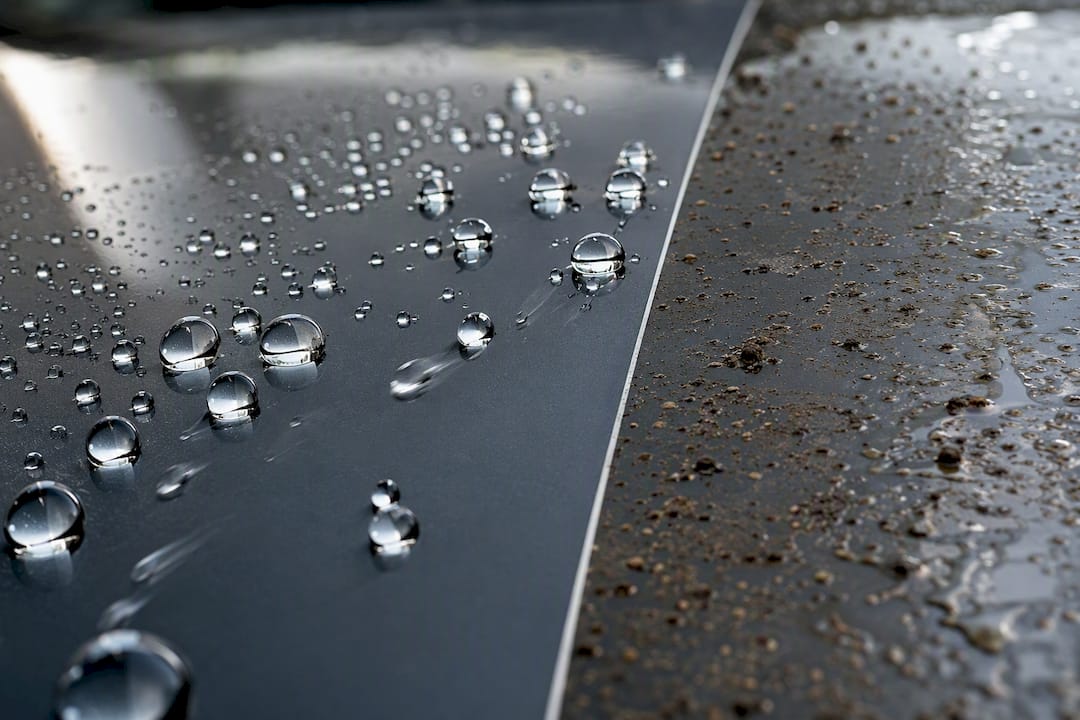
Yes, and this is the piece most owners overlook. A ceramic coating makes paint hydrophobic, meaning water and dirt bead up and slide off instead of clinging to the surface. That translates directly into fewer washes needed per year, since a coated car simply doesn’t accumulate grime the way bare paint does. Sustainability research on automotive detailing confirms that durable coatings and paint protection film reduce both wash frequency and the chemical-intensive repairs that come from UV damage and oxidation over time.
Paint protection film adds a second layer of long-term savings. It absorbs rock chips, scratches, and road debris that would otherwise require paint correction or a full repaint, both of which carry their own environmental cost in solvents, primers, and clear coat. Some PPF installers now use precision-cutting software with digital pattern libraries, trimming material waste during installation compared to old-fashioned manual cutting.
The tradeoffs are real. Coatings and PPF cost more upfront than a single detail, and they still need periodic maintenance washes to perform properly, just far fewer of them.
Ceramic coatings typically need a gentle rinse-and-dry every few weeks rather than a full wash-and-wax cycle.
PPF requires occasional inspection for edge lifting but otherwise needs the same light care as coated paint.
Both pay off fastest for daily drivers, fleet vehicles, or anyone keeping a car for five-plus years, since the water and product savings compound over time.
If you’re weighing whether ceramic coating or paint protection film makes sense for your situation, the sustainability math tends to favor investing once rather than washing conventionally for years.
What Do Eco-Conscious Detailers Actually Do Differently?
The products a detailer uses matter, but the daily operational habits behind the scenes matter just as much, and they’re easier to verify than a bottle label.
Runoff containment. Legitimate eco-focused detailers use containment mats or vacuum systems that capture wastewater before it reaches storm drains, then dispose of it through approved channels rather than letting it run off a driveway.
Microfiber management. Well-run operations wash, inspect, and rotate microfiber towels on a schedule instead of tossing them after a few uses, cutting textile waste and keeping tools performing at full effectiveness.
Route optimization for mobile service. Detailers who batch appointments by neighborhood or corridor cut drive time and fuel use significantly compared to bouncing across a metro area, an approach mobile detailing already tends to support simply by bringing the service to you instead of you driving to a shop.
Rechargeable and energy-efficient equipment. Battery-powered extractors and buffers reduce the fuel a generator would otherwise burn during a full day of mobile appointments.
Operational discipline like this genuinely moves the needle. Guidance on sustainability in the detailing industry points to containment, waste reduction, and route planning as the practices that separate a shop that talks about being green from one that actually operates that way, often while lowering the shop’s own operating costs at the same time.
When you’re vetting a provider, ask whether they can show you an SDS sheet for their main products and whether they have a written runoff policy. A detailer with nothing to hide will usually have an answer ready.
How Do You Choose an Eco-Friendly Detailer?
Booking a green detail should feel less like a leap of faith and more like checking a short list. Here’s what actually separates a detailer who means it from one who’s just using the word as a marketing hook.
Product transparency. They should be able to name the products they use and show you an SDS sheet if asked, not deflect the question.
Containment in practice. Ask directly: “How do you handle runoff?” A real answer mentions containment mats, vacuum recovery, or approved disposal, not a shrug.
Method flexibility. A detailer offering waterless, steam, and low-water reclamation options can match the method to your car’s condition instead of forcing one approach on everything.
Insurance and licensing. Mobile detailing involves working around your property and your vehicle, so basic liability coverage is a baseline expectation, not a bonus.
Pricing that makes sense. Eco-friendly products and containment equipment cost more than a garden hose and a jug of dish soap, so expect prices roughly in line with standard professional detailing, not dramatically cheaper.
Red flags are usually easy to spot once you know to look. A detailer who can’t describe their runoff plan, who washes cars curbside with a hose running straight into the street, or who can’t name a single product they’re using is not operating an eco-conscious business regardless of what their website says.
Should You DIY or Hire a Pro for an Eco-Friendly Detail?
Light, routine maintenance, like a weekly waterless wipe-down or a quick interior steam pass, is safe and effective to do yourself, and it’s genuinely one of the better ways to keep a car clean between professional visits without wasting water. The gear is inexpensive and the learning curve is short.
Heavier jobs are a different story. Ceramic coating application, PPF installation, and steam work around leather or electronics all carry real risk of costly mistakes: a botched coating can trap contaminants under the surface, and PPF applied with air bubbles or misalignment usually means a costly redo. That’s where professional training and equipment pay for themselves.
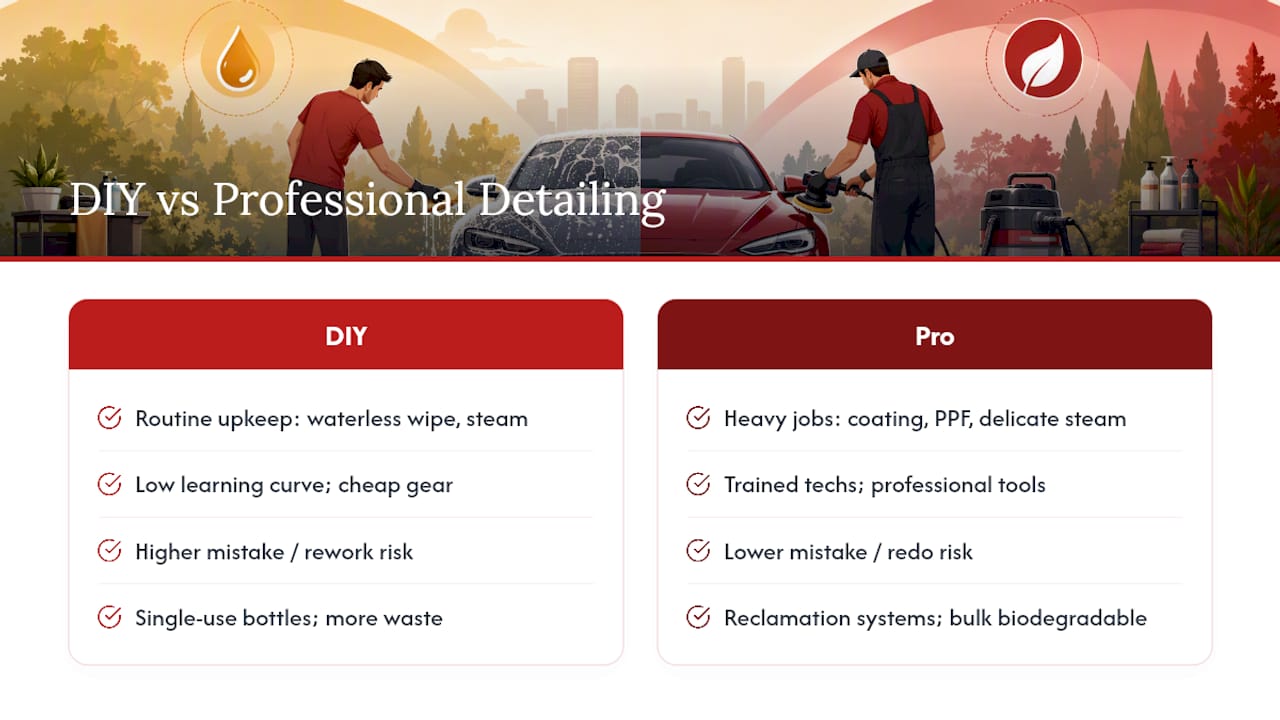
The environmental math tends to favor professionals for anything beyond routine upkeep too. A trained detailer with reclamation systems and bulk-purchased biodegradable products creates less waste per vehicle than a DIYer buying single-use bottles and experimenting with technique. If you’re unsure which category your job falls into, the safer environmental and financial bet is usually to call a pro.
How Phenomenal Auto Care Approaches Eco-Friendly Detailing
We built our mobile process around the idea that convenience and environmental responsibility shouldn’t be a tradeoff. Every appointment, whether it’s a ceramic coating, paint correction, or a full interior detail, uses methods designed to cut water waste and chemical exposure without cutting corners on results.
We’ve built a reputation for applying precise eco-conscious methods to every job.
— Phenomenal
Ready to Book an Eco-Conscious Mobile Detail?
Phenomenal Auto Care brings water-saving methods and non-toxic products directly to your driveway, whether that’s a full ceramic coating, paint protection film, or a routine mobile detail that skips the runoff a traditional car wash sends into the street.

Our mobile setup means we bring the eco-conscious process to you instead of you driving to a shop and adding to your own carbon footprint. On a first visit, expect a walkthrough of your vehicle’s condition, a recommendation on whether a wash, coating, or correction fits your needs, and full transparency on the products going on your car. If you’re near Phoenix, Mesa, or Scottsdale, you can check appointment availability through our mobile detailing service pages or head straight to Phenomenalautocare to book your first eco-conscious detail today.
Sources
Recommended
Comments